


How to Stop Worrying About the Future — A Bhayānaka Rasa Mandala Reflection
Understanding Future Anxiety, Worst‑Case Scenarios, and How Mandala Reflection Helps Separate Facts from Fear

I was once in a relationship that I wanted desperately to work out. The more I tried to hold on, the more anxious I became. My mind kept spinning stories about what might happen next. I imagined worst‑case scenarios, carried constant fear of the future, and lived inside a cycle of overthinking. The relationship itself wasn’t perfect, but my anxiety about the future made it toxic.
Looking back, I wish I had known about mandala reflection and the wisdom of the Navarasas. I wish I had understood the nature of Bhayānaka Rasa, the rasa of fear. It might have saved me from wasting so much energy worrying about the future that hadn’t even arrived.
Why We Start Worrying About the Future
Future anxiety often begins with something small. A friend doesn’t reply. A bill arrives. A medical test is scheduled. You glance at tomorrow’s workload.
Nothing terrible has happened, yet the mind starts imagining the worst. One thought becomes another, and soon we are reacting not to reality but to a future that exists only in our imagination.
Bhayānaka Rasa — Fear of the Future
In the Navarasa tradition, Bhayānaka is the rasa of fear. It is not about danger itself, but about the anticipation of danger.
Fear grows in steps:
Something happens.
The mind interprets it.
A prediction forms.
The body reacts as if the prediction is already true.
A lizard on the wall is a fact. The story that it will jump on you and cause embarrassment is imagination. A low bank balance is a fact. The story that you will lose everything is imagination. A heavy workload is a fact. The story that you will fail completely is imagination.
Bhayānaka reveals how quickly fear and anxiety turn facts into stories.
The Mind’s Disaster Habit
Most of us don’t leap straight into panic. Fear builds step by step. A delayed reply becomes rejection. A mistake becomes failure. A challenge becomes disaster.
At some point, the situation fades and the story takes over. Fear convinces us we cannot handle it, that we will fail, that we will lose everything. This is catastrophic thinking, and it makes worrying about the future feel overwhelming.
The Bhayānaka Mandala Reflection
In our Navarasa Mandala Series, we explored this through a simple mandala practice.
Participants drew a small circle in the centre of the page. Inside it, they placed the trigger — the unanswered message, the bank balance, the workload, the lizard.
Larger circles were added around it, each representing another prediction, another imagined consequence.
On paper, fear escalated quickly. A small concern became a mountain. A mountain became collapse. Collapse became complete failure.
The mandala made something clear: fear grows through imagination. The trigger stayed small. The story became enormous.
Facts vs Predictions
The trigger did not change. The story did. The workload remained the workload. The bank balance remained the bank balance. The unanswered message remained unanswered.
Fear treats predictions as facts. It whispers that because something could happen, it probably will. The body reacts to imagined threats almost as strongly as real ones, which is why future anxiety feels so exhausting.
How to Stop Worrying About the Future
The goal is not to eliminate fear. Fear has a purpose. It helps us notice risks and stay safe. The problem begins when fear writes the entire story.
When that happens, ask yourself:
What is the actual trigger?
What do I know for certain?
What am I predicting?
What evidence supports that prediction?
Which circle am I in — reality or imagination?
Often, that question alone creates enough distance to see things differently.
A Gentle Reflection
If you have been worrying about the future, sit with these questions:
What am I afraid might happen?
What is the situation right now?
What part is fact?
What part is prediction?
What story have I added?
Fear often shrinks the moment it becomes visible.
The Quiet Gift of Bhayānaka
Fear is not the enemy. It is an emotion trying to protect you. Most of the things we fear never unfold exactly as imagined, yet we spend enormous energy living through them in advance.
Bhayānaka reminds us that fear is not the problem. The challenge is recognising when fear is helping us respond to reality and when it is simply telling stories.
The future does not need to be solved today. It only needs to be met when it arrives.
Explore the Navarasa Mandala Series
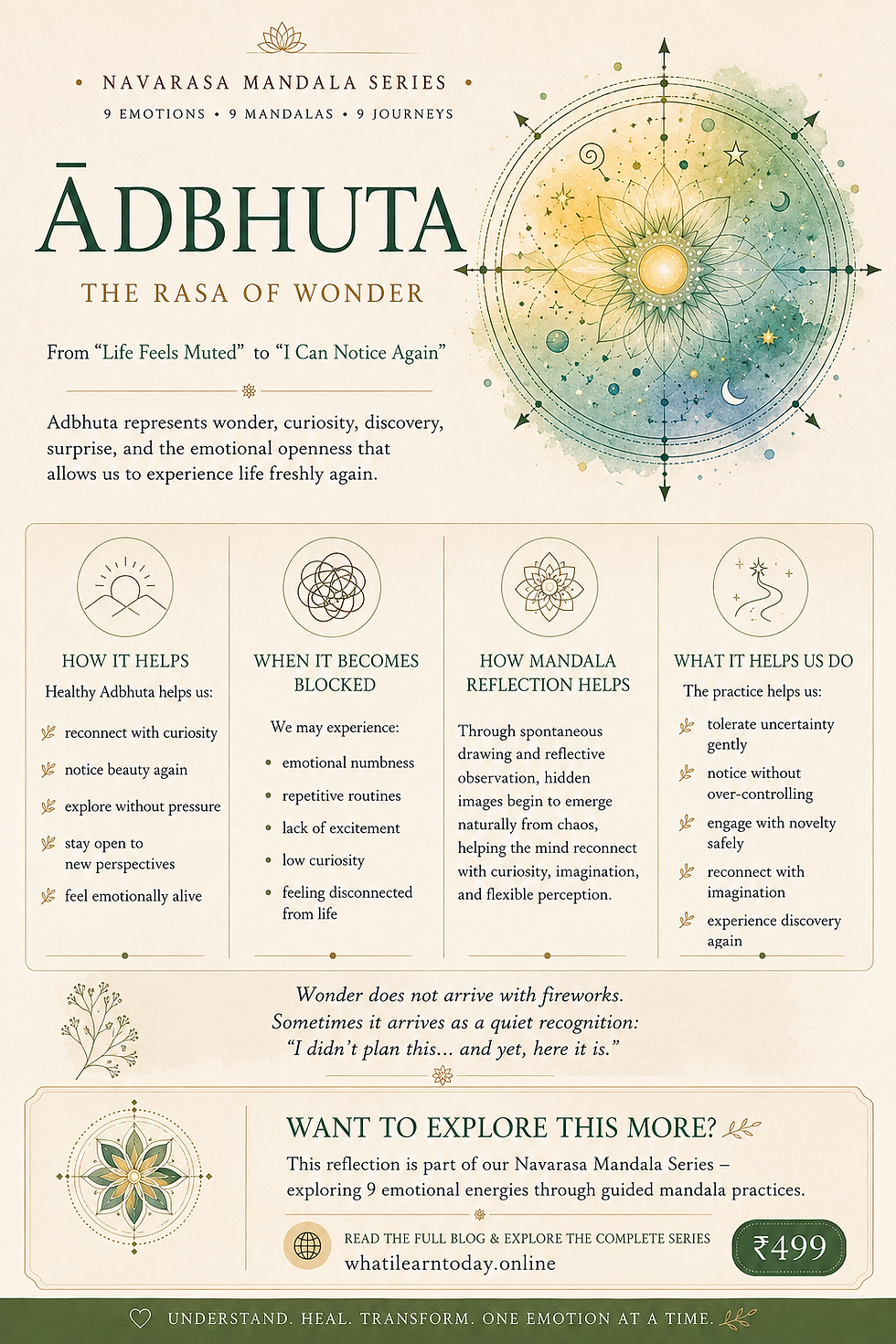
Bhayānaka is one of nine emotional journeys in our Navarasa Mandala Series. Each guided reflection explores a different emotional landscape — courage, wonder, sorrow, fear, love, and peace.
At What I Learnt Today, we use mandala art as a tool for emotional healing, self‑discovery, and quiet reflection.
You don’t need to be an artist. Just willing to sit honestly with what you feel.
🎨 9 emotions • 9 mandalas • 9 guided journeys ✨ Complete recorded series • ₹499 👉 Buy the Navarasa Mandala Series: https://pages.razorpay.com/NavarasaMandalas


Comments