


Why Some Sadness Stays With Us — A Karuṇā Rasa Mandala Reflection on Sorrow, Self‑Compassion and Emotional Healing
Emotional Heaviness, Grief, and How Mandala Reflection Helps Us Be Kinder to Ourselves

Life goes on — we work, care for others, meet deadlines, pay bills. Yet beneath it all, something feels heavier. Not dramatically, just quietly. Like carrying a bag that grows heavier each year because we never stop to put it down.
This quiet sadness and emotional exhaustion is one of the experiences explored through Karuṇā Rasa in the Indian Navarasa tradition.
Karuṇā Rasa: From Sorrow to Self‑Compassion
Karuṇā is often translated as compassion, but it begins with sorrow — the grief of loss, heartbreak, disappointment, or longing. In the Navarasa tradition, Karuṇā honours sadness as a deeply human response, not something to be avoided.
When sorrow is allowed to be felt instead of resisted, it transforms. Grief softens. Pain becomes understanding. Compassion emerges — not only for others, but for ourselves.
Why Sadness Lingers
We’re told to move on, stay positive, be strong. But emotions don’t follow schedules.
Sadness remains when it isn’t given space.
Grief lingers when we’re too busy surviving to feel it.
Wounds stay open when we judge ourselves for having them.
Over time, the effort of suppressing pain drains us more than the pain itself. This is why self‑compassion matters — not as a slogan, but as a new way of relating to our own experience.
Mandala Reflection for Emotional Healing
In our Mandala Healing Huddles, we use guided mandala reflection to explore emotions through art, symbolism, and the wisdom of the Navarasas.
A mandala creates a visual space where feelings can be expressed and held safely. This is especially powerful for grief and sadness, which often live in the body before they can be spoken. Through colour, texture, and form, emotions take shape — and once visible, they become easier to approach with kindness.
The Karuṇā Mandala Practice
We began with a simple question: Where does sorrow live in your body?
Tightness in the chest.
Heaviness in the throat, stomach, jaw, or behind the eyes.
Participants drew what the sorrow felt like — tangled lines, heavy shapes, dark colours. Not to make art, but to acknowledge what was present.
Then:
A circle was drawn around the sorrow — a safe container.
The circle was gently erased — symbolising release from holding it too tightly.
A new circle was drawn in yellow — representing self‑compassion, softness, permission.
A protective boundary completed the mandala — not fear, but care for tenderness.
What Self‑Compassion Really Means
Self‑compassion is not self‑pity, avoidance, or pretending everything is fine.
It is meeting your own pain with the same understanding you’d offer someone you love. Most of us know how to comfort a friend. Yet when we are hurting, we often become our own harshest critic.
Karuṇā invites a different question: Not “Why am I still feeling this?” but “What do I need right now?”
That shift changes everything.
A Gentle Reflection
If you’ve been carrying heaviness, sit with these questions:
What sadness am I still carrying?
What disappointment have I not acknowledged?
Where do I feel this in my body?
What would it look like to respond with kindness instead of criticism?
Healing doesn’t always begin when pain disappears. Sometimes it begins when pain is finally witnessed.
The Quiet Gift of Karuṇā
Karuṇā doesn’t ask us to be stronger. It asks us to be gentler.
Sadness is not weakness. It is evidence that we cared, hoped, loved — that something mattered.
Sometimes emotional healing begins not when pain leaves, but when compassion arrives.
Explore the Navarasa Mandala Series
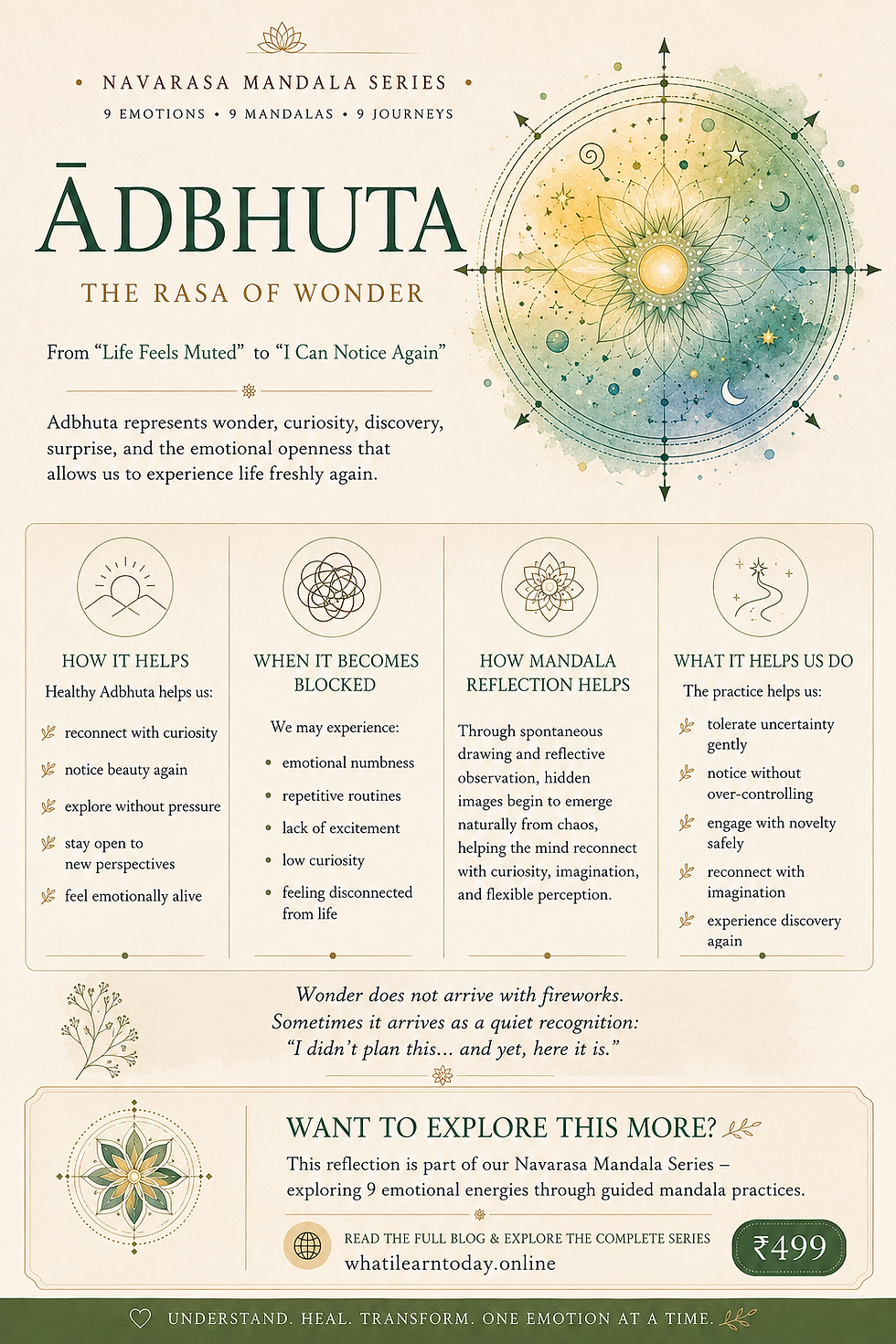
Karuṇā is one of nine emotional journeys in our Navarasa Mandala Series. Each guided reflection explores a different emotional landscape — courage, wonder, grief, fear, love, peace, and more.
At What I Learnt Today, we use mandala art as a tool for emotional healing, self‑discovery, and quiet reflection.
You don’t need to be an artist. Just willing to sit honestly with what you feel.
🎨 Complete recorded series • ₹499 👉 Buy the Navarasa Mandala Series

Comments